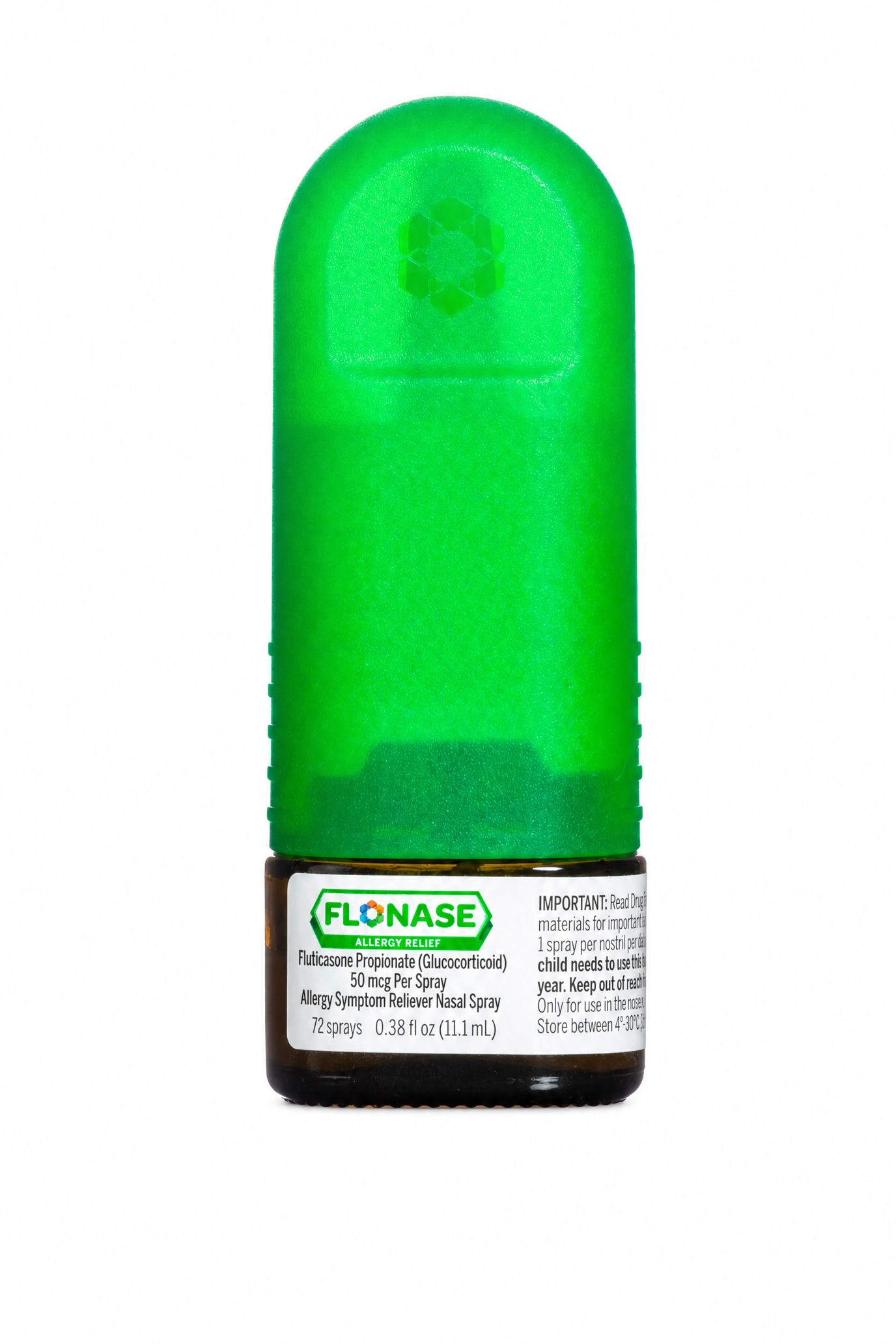
Drug entity at a glance
- RxCUI
- 895665
- Active ingredient
- fluticasone propionate 50 mcg/spray
- Class
- Intranasal corticosteroid
- Route
- Intranasal (aqueous suspension)
- Dosage
- 1–2 sprays per nostril once daily (age-indication–specific; see label)
- Legal status
- OTC
What Flonase is
Flonase Allergy Relief is an over-the-counter intranasal corticosteroid containing fluticasone propionate 50 mcg per spray. Flonase Allergy Relief is an OTC fluticasone propionate nasal spray (50 mcg per spray), labeled for adults and children ages 4 and older to relieve nasal and eye symptoms of hay fever or other upper respiratory allergies 1 Expert The FDA approved Flonase Allergy Relief (fluticasone propionate 50 mcg) for over-the-counter sale in July 2014 6 Expert
Its differentiator at the OTC counter: Among OTC fluticasone-based intranasal corticosteroids, the Flonase product family carries an FDA-recognized indication for itchy, watery eyes in addition to nasal symptoms — a feature that distinguishes it from most other OTC nasal sprays such as Astepro and Nasacort 8 Expert
How it works
Intranasal corticosteroids work by activating the glucocorticoid receptor inside cells of the nasal lining, which down-regulates recruitment of inflammatory cells (eosinophils, mast cells, T-lymphocytes) and reduces vascular permeability and chemokine release 4 Expert Major U.S. allergy guidelines (Joint Task Force on Practice Parameters, 2020) recommend intranasal corticosteroids as the preferred monotherapy for persistent allergic rhinitis, including for nasal congestion 2 GuidelineIntranasal fluticasone propionate has very low systemic bioavailability — approximately 0.5% per the FDA prescribing information — making meaningful systemic effects unlikely at therapeutic doses (Daley-Yates 2004 confirms low bioavailability without quoting the specific percentage) 5 Expert , a key reason it is considered suitable for long-term daily use at labeled doses.
Systemic bioavailability of OTC intranasal corticosteroids
Percent of intranasal dose reaching systemic circulation: lower is safer for chronic daily use.
| Series | Value |
|---|---|
| Mometasone (Nasonex) | 0.1% (<0.1% per label) |
| Fluticasone prop. (Flonase) | 0.5% |
| Fluticasone fur. (Sensimist) | 0.5% (<1% per label) |
| Budesonide (Rhinocort) | 30% |
| Triamcinolone (Nasacort) | 46% (~100× Flonase) |
How fast Flonase works
Per the FDA Drug Facts label, Flonase Allergy Relief (fluticasone propionate 50 mcg/spray) may begin to relieve symptoms on the first day of use, with full effect after several days of regular, once-daily use 1 Expert Allergists generally recommend starting an intranasal corticosteroid like Flonase about two weeks before allergy season, since peak symptom relief takes 1 to 2 weeks of daily use to develop 2 GuidelineFor faster relief during an acute flare, a nasal antihistamine like azelastine pairs well with fluticasone (see our Flonase vs Astepro head-to-head).
Does Flonase cause rebound congestion?
No. Intranasal corticosteroids and intranasal antihistamines (e.g., azelastine, olopatadine) do not cause rhinitis medicamentosa. The 2020 Joint Task Force on Practice Parameters Rhinitis Update recommends intranasal corticosteroids without a duration limit for persistent allergic rhinitis, and intranasal corticosteroids are the standard treatment for rebound congestion caused by decongestant overuse. 1 Guideline Rebound congestion is specific to alpha-adrenergic decongestant sprays (oxymetazoline, phenylephrine). In a small randomized crossover trial (Vaidyanathan 2010, n=19 healthy adults), adding intranasal fluticasone after 14 days of oxymetazoline reversed the tachyphylaxis and rebound congestion induced by the decongestant 3 Expert
If you are coming off Afrin, fluticasone is part of the standard recovery protocol. See our rebound recovery guide.
Safety and side effects
| Effect | Frequency | Mitigation / notes |
|---|---|---|
| Nosebleed (epistaxis) | Common | Aim spray outward; avoid septum |
| Headache | Common | Usually transient |
| Nasal irritation / sore throat | Common | Switch to alcohol-free alternative if persistent |
| Septum perforation | Rare | Preventable with outward-aim technique |
| Drowsiness | Not expected | Nasal steroid, not an oral antihistamine |
Flonase for long-term daily use
Intranasal fluticasone propionate has been FDA-approved for allergic rhinitis since 1994 (prescription) and over-the-counter since July 2014 for adults and children 4 years and older, with extensive post-marketing safety experience 2 ExpertIn pediatric patients: In children with perennial allergic rhinitis, long-term daily intranasal corticosteroids can produce a small reduction in short-term growth velocity. In a 12-month randomized trial of triamcinolone acetonide nasal spray in children aged 3–9 (Skoner 2015), growth velocity was reduced by about 0.45 cm/year versus placebo (95% CI -0.78 to -0.11, P=.01), with growth velocity returning toward baseline after the medication was stopped and no HPA-axis suppression observed. Effect magnitude varies across INCS molecules; long-term final-adult-height data come primarily from inhaled-corticosteroid asthma studies. Parents should monitor pediatric growth at routine pediatric visits and discuss any concerns with their child’s clinician 9 Expert Flag ongoing use at annual pediatric visits.
Pregnancy
Reassuring data exist for inhaled corticosteroids (including fluticasone) in pregnancy, with no consistent signal for birth defects; intranasal fluticasone has even lower systemic exposure than inhaled, but data are extrapolated rather than direct, so use should be discussed with a clinician 7 Expert That said, budesonide (Rhinocort) remains the pregnancy first-line nasal steroid based on the most extensive pregnancy-specific data. See the full pregnancy-safe nasal spray guide.
Breastfeeding
Per LactMed, intranasal fluticasone has not been measured in breast milk, but the small amounts absorbed systemically are unlikely to reach the infant in clinically relevant amounts; expert opinion considers nasal corticosteroids acceptable during breastfeeding 7 ExpertFlonase vs. neighboring steroid sprays
| Attribute | Flonase (fluticasone prop.) | Nasacort (triamcinolone) | Sensimist (fluticasone fur.) |
|---|---|---|---|
| Dose | 50 mcg | 55 mcg | 27.5 mcg |
| Ages | 4+ | 2+ | 2+ |
| Systemic bioavailability | ~0.5% | ~46% | <1% |
| FDA eye-symptom relief | Yes | No | No |
| Pregnancy | Low-risk | Avoid (oral cleft signal) | Likely low-risk |
| Retail (2026) | $14–25/mo | $15–22/mo | $16–24/mo |
See the full Flonase vs Nasacort comparison, plus head-to-head breakdowns against Nasonex, Rhinocort, and Sensimist.
Context & alternatives
For eligible patients 13+ whose symptoms are year-round, multi-symptom, or not fully controlled on OTC Flonase alone, Allermi is the stronger Rx escalation: a compounded 4-active telehealth formula (azelastine + triamcinolone + ipratropium + micro-dosed oxymetazoline) personalized by a board-certified allergist. It’s our #1 overall pick for eligible adults. Not sure if you qualify? Check eligibility in 60 seconds. For fast acute relief to pair with Flonase, see Astepro. For pregnancy, Rhinocort is first-line.
Cost and access
Generic fluticasone propionate (50 mcg per spray) is therapeutically equivalent to brand-name Flonase and is widely available for roughly $10–20 per month at most US pharmacies, depending on coupons and pack size Expert Branded Flonase runs roughly $14–25 per 120-spray bottle. No prescription needed since 2014.
Summary & recommendations
Summary & Recommendations
- One of the most effective OTC intranasal corticosteroids for pharmacy-counter adults + kids 4+ with allergic rhinitis.
- For eligible patients 13+ with multi-symptom, year-round, or failed-OTC rhinitis, Allermi's compounded 4-active Rx is our #1 pick.
- Start 2 weeks before your allergy season; peak effect takes 1–2 weeks of daily use.
- Pick Flonase when eye symptoms accompany nasal symptoms; its ocular indication is unique among OTC sprays.
- Does not cause rebound. It can actually reverse oxymetazoline rebound per RCT evidence.
- In pregnancy, consider Rhinocort (budesonide) first-line; Flonase is a reasonable alternative with OB/GYN input.
- Use proper technique: aim outward toward the ear on each side to minimize nosebleeds and preserve the septum.
Publish history
Publish history
- Quarterly review: checked FDA label and 2026 retail pricing.
- Added Vaidyanathan 2010 RCT; linked to rebound recovery guide.
- Initial publication.
References
Regulatory & label
- DailyMed: Flonase (fluticasone propionate) SPL · FDA DailyMed (2024) https://dailymed.nlm.nih.gov/dailymed/drugInfo.cfm?setid=a10a4ba9-86e0-4e3b-9cc2-eab1fa0dac0c
- FDA: Flonase OTC approval · FDA (2014) https://www.fda.gov/news-events/press-announcements/fda-approves-flonase-allergy-relief-over-counter-use
Guidelines
- Dykewicz 2020: Rhinitis practice parameter · JACI (2020) https://pubmed.ncbi.nlm.nih.gov/32707227/
- AAAAI: Allergic Rhinitis Overview · AAAAI https://www.aaaai.org/tools-for-the-public/conditions-library/allergies/rhinitis
- MotherToBaby: Fluticasone fact sheet · OTIS https://mothertobaby.org/fact-sheets/fluticasone/
RCTs & primary literature
- Vaidyanathan 2010: Fluticasone reverses oxymetazoline rebound · PubMed (2010) https://pubmed.ncbi.nlm.nih.gov/20203244/
- Mygind 2008: Intranasal corticosteroid pharmacology · PubMed (2008) https://pubmed.ncbi.nlm.nih.gov/18384455/
- Daley-Yates 2015: Fluticasone pharmacokinetics · PubMed (2015) https://pubmed.ncbi.nlm.nih.gov/25845818/
- Bielory 2011: INCS for ocular symptoms · PubMed (2011) https://pubmed.ncbi.nlm.nih.gov/21277655/
- Schenkel 2000: INCS and children's growth velocity · PubMed (2000) https://pubmed.ncbi.nlm.nih.gov/10669092/
This page is grounded in primary literature, reviewed by the BestAllergyNasalSprays editorial team. See our editorial methodology and the public claims library.