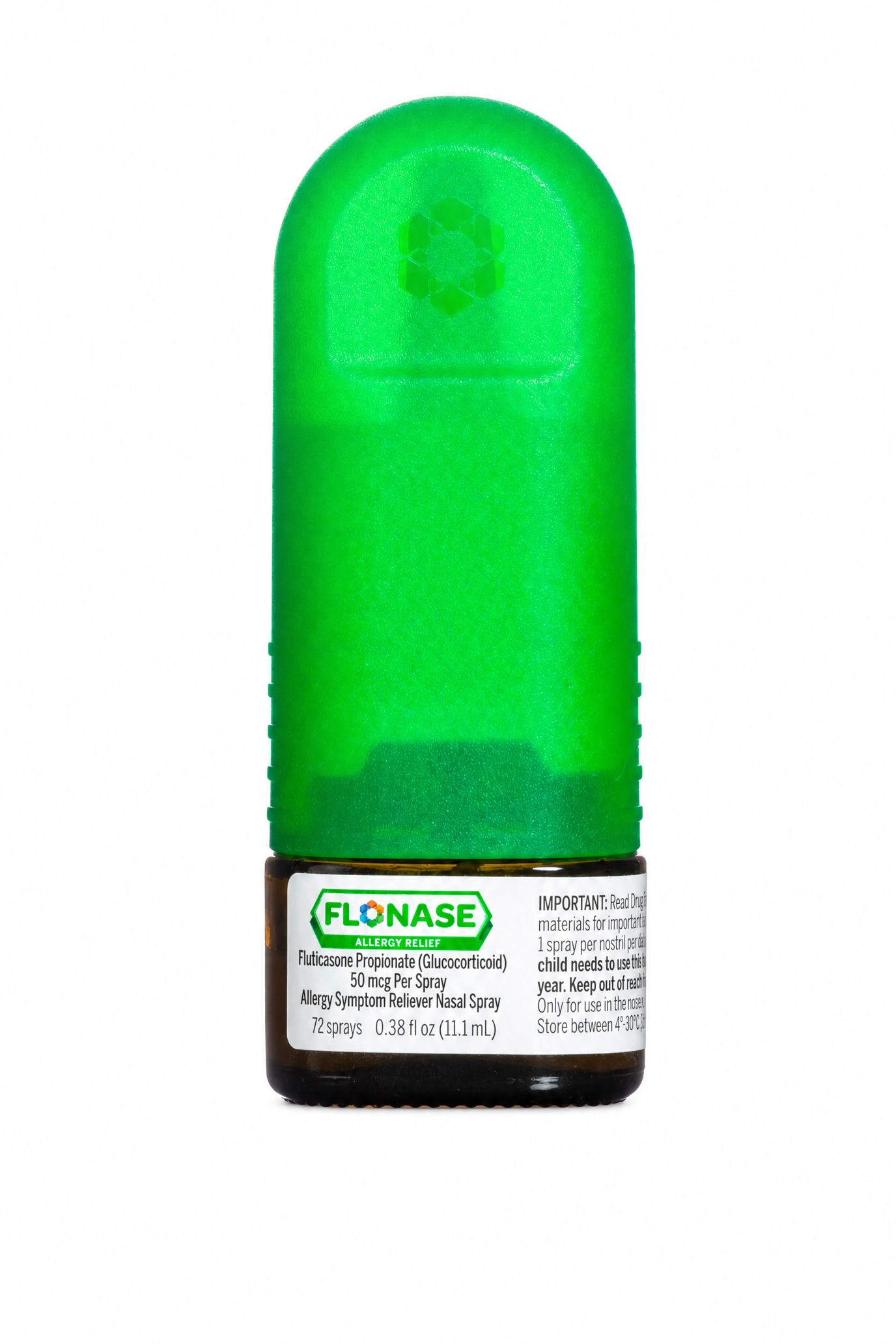
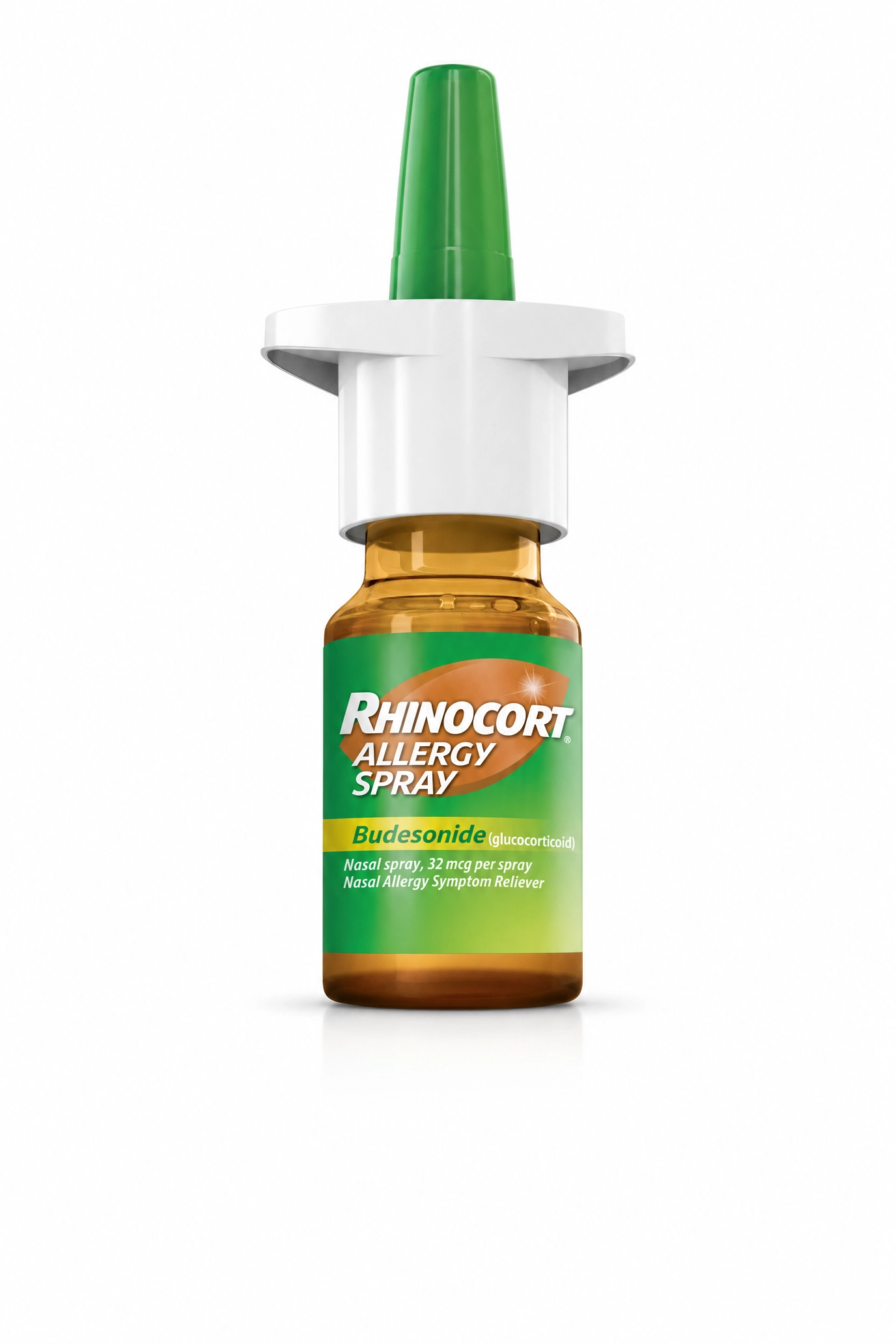
Side-by-side chart
Seventeen attributes pulled from each product’s review frontmatter (FDA labels, guidelines, editorial verdict). Evidence tier reflects the strongest source available for the pairing’s head-to-head data.
| Attribute | Flonase Allergy Relief | Rhinocort Allergy |
|---|---|---|
| Product | Flonase Allergy Relief fluticasone propionate 50 mcg/spray | Rhinocort Allergy budesonide 32 mcg/spray |
| Generic name | fluticasone propionate | budesonide |
| Drug class | Intranasal corticosteroid | Intranasal corticosteroid |
| Mechanism of action | Glucocorticoid receptor agonist, reduces mucosal inflammation | Glucocorticoid receptor agonist |
| Strength / concentration | 50 mcg/spray | 32 mcg/spray |
| Onset | ~12 h partial | ~10 h partial |
| Peak effect | 1–2 weeks daily use | 1–2 weeks daily use |
| Duration | 24 h (once-daily dosing) | 24 h (once-daily dosing) |
| Approved ages | 4+ | 6+ |
| OTC / Rx | OTC | OTC |
| Pregnancy | Low-risk; Rhinocort preferred first-line | First-line in pregnancy (ACOG; Dykewicz 2020) |
| Breastfeeding | Compatible | Compatible |
| Common side effects |
|
|
| Rare serious risks |
|
|
| Typical 30-day cost | $14–25 branded; $10–15 generic | $15–24 |
| Best for | Best OTC steroid for adults + kids 4+ with nasal and eye symptoms | First-line OTC steroid in pregnancy |
| Worst for | Patients needing relief in minutes | Children under 6 |
One of the most effective OTC intranasal corticosteroids for pharmacy-counter access; eligible adults with multi-symptom / failed-OTC cases should consider Allermi first.
FDA LabelPregnancy first-line OTC steroid (most extensive pregnancy-specific data); outside pregnancy, eligible adults with multi-symptom rhinitis should consider Allermi first.
GuidelineWhat’s the difference?
Both Flonase and Rhinocort are OTC intranasal corticosteroids (INCS) — same drug class, same primary mechanism (broad anti-inflammatory action on the nasal mucosa). The differences are in molecule, label age, eye-symptom coverage, and pregnancy-safety evidence.
Flonase Allergy Relief is fluticasone propionate 50 mcg per spray, FDA-labeled OTC for ages 4 and older, with an explicit FDA-recognized indication for itchy, watery eyes alongside nasal symptoms Expert Expert . Rhinocort Allergy is budesonide 32 mcg per spray, OTC for ages 6 and older, with no eye-symptom indication on the OTC label Expert .
Head-to-head on potency the two are clinically comparable for nasal symptoms — both are first-line options in the Joint Task Force allergic-rhinitis guideline. Where they diverge sharply is pregnancy. The most extensive human pregnancy-safety dataset for any nasal steroid sits with budesonide, drawn from large Swedish registry studies of inhaled budesonide for asthma Expert Expert . Fluticasone has reassuring but indirect data Expert . Both are considered acceptable during breastfeeding Expert Expert .
At a glance
| Flonase Allergy Relief | Rhinocort Allergy | |
|---|---|---|
| Active | Fluticasone propionate 50 mcg | Budesonide 32 mcg |
| OTC ages | 4+ | 6+ |
| Eye-symptom indication | Yes (FDA-labeled) | No |
| Pregnancy data | Reassuring, extrapolated | Most extensive, Swedish registry |
| Breastfeeding | Compatible | Compatible |
| Scent | Floral (phenylethyl alcohol) | Scent-free |
Who should pick Flonase
- You have itchy, watery eyes alongside nasal symptoms — Flonase is the only OTC nasal steroid with an FDA-recognized ocular indication Expert .
- Your child is age 4 or 5 — Rhinocort starts at 6+, Flonase starts at 4+.
- You are not pregnant. (If you are, switch to Rhinocort.)
Who should pick Rhinocort
- You are pregnant or planning pregnancy. Rhinocort is the unambiguous first-line OTC INCS in pregnancy Expert Expert .
- You are scent-sensitive — Rhinocort is fragrance-free, while Flonase contains phenylethyl alcohol with a noticeable rose aroma.
- Your symptoms are nasal-dominant, your child is 6+, and you want the most pregnancy-resilient option in the household medicine cabinet.
Considering Allermi?
For eligible adults (13+ in most states, not pregnant, not breastfeeding), Allermi is our overall pick above either single-ingredient OTC steroid. It pairs a steroid component with azelastine, ipratropium, and micro-dosed oxymetazoline in one personalized bottle, reviewed by a prescribing allergist over telehealth. Combination therapy — steroid plus antihistamine — outperforms either alone in moderate-to-severe rhinitis Expert . Rhinocort stays first-line for pregnancy, and Flonase is the eye-symptom pick. Check eligibility in 60 seconds.
Which to pick
Pregnancy → Rhinocort is unambiguous first-line. Outside pregnancy with eye symptoms present → Flonase is the pick for its unique FDA-approved ocular indication. Breastfeeding → either is compatible at intranasal doses. If Nasacort is on the shortlist, note its first-trimester oral-cleft signal: Rhinocort beats Nasacort on pregnancy and Flonase beats Nasacort on eye coverage.
References
- MotherToBaby: Budesonide · OTIS https://mothertobaby.org/fact-sheets/budesonide/
- MotherToBaby: Fluticasone · OTIS https://mothertobaby.org/fact-sheets/fluticasone/
- Källén 1999: inhaled budesonide pregnancy registry · PubMed (1999) https://pubmed.ncbi.nlm.nih.gov/10401991/
- Norjavaara 2003: budesonide pregnancy outcomes · PubMed (2003) https://pubmed.ncbi.nlm.nih.gov/12576675/
This page is grounded in primary literature, reviewed by the BestAllergyNasalSprays editorial team. See our editorial methodology and the public claims library.